Do Kitchen Islands Need to be Centered?
Quick answer
No. An island should be placed where it leaves enough clearance to work and walk around it, not necessarily in the middle of the room. The National Kitchen & Bath Association recommends a work aisle of at least 42 inches for one cook and 48 inches for two or more, and at least 36 inches for a walkway where nobody is working.
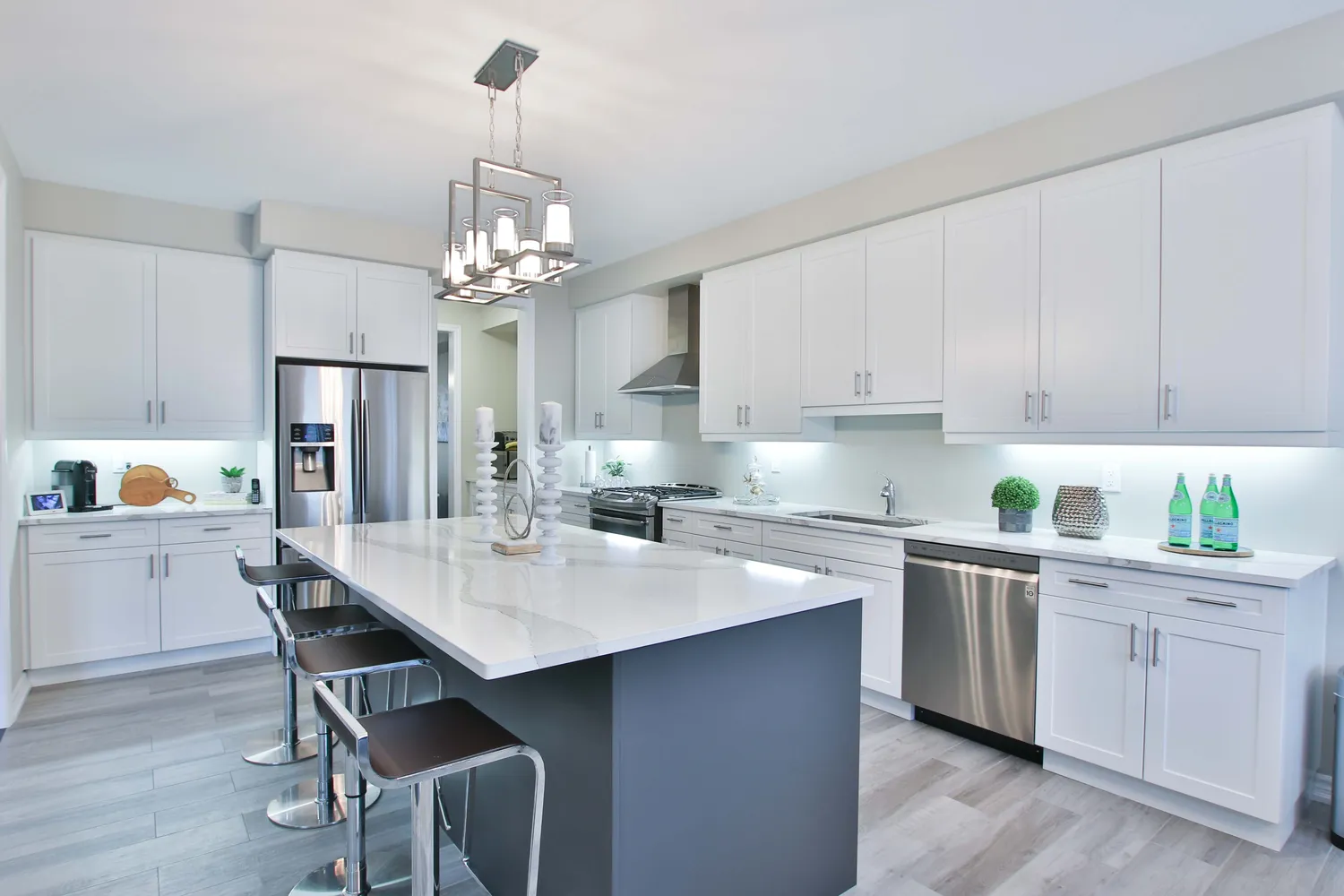
An island doesn’t have to sit in the exact centre of the kitchen. What matters is that it fits the way you cook and leaves enough room around it. In many kitchens the best spot is slightly off-centre, closer to the main run of cabinets and appliances.
How much space do you need around an island?
These are the National Kitchen & Bath Association (NKBA) planning guidelines most kitchen designers work from:
| Space | Recommended minimum |
|---|---|
| Work aisle, one cook | 42 in (107 cm) |
| Work aisle, two or more cooks | 48 in (122 cm) |
| Walkway (no one working there) | 36 in (91 cm) |
A work aisle is the gap between the island and the counter or appliances opposite it. Measure from the edge of the countertop, not the cabinet doors, and remember that an open dishwasher or oven door sticks out into that space.
If your kitchen can’t give those clearances on every working side, a smaller island, a narrow peninsula or a movable kitchen cart may work better than a fixed island.
How to decide where to put it
- Work out its job first. An island used mainly for prep should be close to the fridge and sink. One used for clean-up needs to be near the dishwasher and bin. One used mainly for seating can sit further from the cooking zone.
- Keep the main work triangle clear. Avoid putting the island where people will have to walk around it constantly to get between the sink, cooktop and fridge.
- Think about traffic. If the island sits between the kitchen and a doorway or dining area, leave a clear walkway that doesn’t cross the cook’s work space.
- Leave room for doors and drawers. Check that cabinet doors, drawers and appliance doors on both the island and the opposite wall can open fully at the same time.
Should a kitchen island be the same height as the counter?
It can be either. Standard counter height in the US is 36 inches, and a single-level island at the same height gives you one large continuous work surface. That suits cooking, baking and serving buffets.
A raised “bar height” ledge at around 42 inches hides kitchen clutter from the living area and acts as a partial room divider. The trade-off is a smaller work surface and bar stools instead of counter stools. A two-level island combines the two.
How much seating fits at an island?
The NKBA recommends allowing about 24 inches of width per seated person. The knee space needed under the overhang depends on the counter height:
| Counter height | Width per person | Knee space depth |
|---|---|---|
| 30 in (table height) | 24 in | 18 in |
| 36 in (counter height) | 24 in | 15 in |
| 42 in (bar height) | 24 in | 12 in |
So a 6-foot (72-inch) island seats three people comfortably along one side.
Things to plan for before you build
- Electrical outlets. Electrical code rules for island outlets vary by location and have changed in recent code editions, so ask your electrician what applies where you live. Outlets on an island are useful for small appliances either way.
- Cooktop or sink in the island. Both make the island more useful but need plumbing, ventilation or both. An island cooktop needs a ceiling hood or a downdraft vent.
- Lighting. Pendant lights over an island give task lighting for prep and make the island a focal point. Hang them high enough not to block sight lines across the room.
- Storage. Drawers are usually more useful than deep cupboards in an island, because you can see everything without kneeling.